

Thursday, July 4, 2019
Thursday, November 22, 2018
Happy Thanksgiving and Gratitude for Chickens, People, All Blessings

Greetings and best wishes to all who read this!
Monday, September 3, 2018
Backyard Chicken Keeper Enhances Dictionary Meaning of "Chickens" To Match Current Usage

It's a matter of opinion, of course. Do you have any thoughts on it? How would you define chickens today?
If we're very interested in a topic, then beginning with a clear and complete definition seems like a good idea.
Regarding the new blog banner just published above, someone asked "what makes chicken exhibition prestigious"? You probably know that a long time ago, Queen Victoria awakened her staff, friends and other members of the royal family of Great Britain to becoming 'chicken fanciers'. It spread quickly to the population in general.
Being Queen is a prestigious position, therefore backyard chicken keeping and exhibition is a prestigious hobby. A brilliant leap of logic, of course. 😊 Not that anyone chooses a hobby for that reason, of course!
I'm becoming more and more an advocate for backyard chicken keepers learning what exhibitors must know and do, whether or not they show their chickens.
It's how people learn about classes, breeds, varieties, strains, and so much more. Knowledge is power, and it makes us self-sufficient, too. Imagine not needing to ask someone else to identify the breed of your chicken, for example!
It's a way to enjoy visiting shows more, taking great photos of your favorite chickens after you've bathed them, and taming them so they're easier to check on.
I saw a blog that said backyard chicken keeping should be more highly regulated. Then, some survey respondents admitted a weakness in their knowledge of biosecurity, health assessments, and diseases. YIKES!
It's understandable that the commercial egg and meat industries would be worried . . . chickens do feed the entire world. And, it is possible for disease to spread from backyard chickens if we don't know how to identify ill birds or follow guidelines for optimum care.
The survey was taken in 2013, though, so hopefully there has been an improvement.
Do you have an opinion you'd like to share ? Think we should each make more effort to share what we know ?
Monday, July 3, 2017
Celebrate! Having it all means Freedom, Liberty,and a Chicken Flock

Just want to wish all my Fellow Americans a
Very Happy 4th of July!
Much appreciation and gratitude to all Veterans and those
currently serving !
GOD BLESS ! !
After visiting nine other countries, primarily compliments of the U.S. Military this is still
HOME SWEET HOME
Saturday, June 24, 2017
Foster Mama Hens in the Brooder - A New Twist on Feather Dusters

When a mama hen abandons her chicks midway through brooding them, what can you do to save those babies and bring them up to be happy healthy adult chickens? I was faced with that dilemma last week, for the first time. Unusual for an Old English game hen, but there's a first time for everything. Papa Rooster is an Old English game, too - these will be pretty chickens!
I had heard of people using a feather duster as a 'foster mama hen', so when these four little chicks (4th is partially visible, upper left) were orphaned by their indecisive mama, I went shopping. I had settled the poor little orphans in a small brooder meant for up to ten baby chicks, and added the new feather duster when I got home from work the next day. It's similar to the color of the hen, and I'm thrilled to say they are thriving now!
They snuggle together under those soft feathers and sleep snug as little bugs in a rug.
Yesterday, it was warm and sunny, so they had a little field trip . . . long enough to get this photo, anyway.
Watching baby chicks who've imprinted on a feather duster is far more fun than using it for its intended purpose. 😊
Have you faced this issue - how did you deal with it?
Wednesday, March 15, 2017
Winter challenges with Chickens

Worst Winter in a while for the North Cascades
'Harriet' may be ready to attend her first garden party of spring, but my current flock is just happy to see 48-degree temperatures and melting snow. Me too!
Power outages, ice everywhere and road conditions that ramped the stress up to heart attack level brought to mind a vision of Florida, except for the lack of gorgeous far-away snow covered mountain tops and evergreen trees. Funny how you get so attached to a specific topography.
Good news, my chickens are doing well! Fortunately, my chicken coop is insulated with tar paper between the siding and wall. Temps got down to about 20 degrees some nights, and water had to be changed more often, but, like they say, excess heat is worse for chickens than cold.
It wasn't cold enough to cause frost-bite of the single combed roosters, that probably happens more on the east coast, or eastern Washington. You probably know to rub the combs with a little Vaseline, if it's super cold where you are.
I feed my birds more scratch than normal when it's cold, they need extra carbs to keep their body heat up.
It was nerve wracking to see a red fox circling my place, but so far, no winter predator losses.
This is the first winter in more than a decade where I live with so much snow, and for so long a time. With 4-wheel drive snow isn't that hard to drive in; just have to watch out for the 'hot-shots' that pass you by like you're standing still - they slow traffic when they wind up in the ditch or wrapped around a pole within a couple of miles. The ice is really treacherous, though,especially on steel bridges.
Even though winter hasn't completely said 'adios', a lot of people I know have decided to get started with chickens. Problem is, they can't get to the feed store early enough . . . baby chick shipments are selling out in just a few hours! Spring has definitely almost 'sprung'.
Everyone wants Rhode Island Reds! Great layers, that's for sure.
If you shop at the feed store for baby chicks be sure to learn what the baby chicks of the breed you want look like - before you shop. Sometimes they have 8 or 10 tubs, and when one is almost empty they combine the breeds to keep all of them warm. You can find pictures of the adults and babies on the websites of a lot of the hatcheries. You won't want to end up with broilers if you're only interested in eggs.
Happy Spring and Fun Chicken Keeping!
Wednesday, February 1, 2017
Baby Chicks, Valentines Day, Chicken Breeds, and Taming Your Flock
| A Carrie Wood Graphic, blended with love and with gratitude to the artists/photographers at Pixabay.com |

It's that month of tantalizing chocolates, wine and long-stemmed red roses, sparkling baubles, and a certain question being 'popped' (sometimes wished for - sometimes not).
But for some of us, (also known as the chicken 'afflicted'-or 'addicted'), it's also time to think about brooders, fluffy baby chicks like the one above and . . . a future filled with your very own 'farm fresh home-grown eggs' for breakfast! "YES"!
To ensure harmony in the home, we should never forget those highly anticipated symbols of romance. (That $25 or above purchase could save a bundle) 😉.
However, February is also a great month to take some time studying chicken breeds, and think about our purpose in getting baby chicks (eggs, meat, dual purpose, exhibition?).
There is a lot to learn in recognizing breeds and varieties of chickens . . . commit it to memory, though and it won't leave you. Once a breed is accepted by the American Poultry Association (or another country's equivalent) and published in the American Standard of Perfection you can consider it to be rather permanent.
It's a rewarding mental exercise; at least that's the opinion of this book-worm.
Every breed is required to have:
- A specific type of comb (and wattles). Single, Rose, Strawberry, Pea, Cushion, V-comb, Buttercup, Silkie (Walnut)
- Skin color
- Earlobe color
- Number of toes (4 or 5)
- Leg color
- Body shape - "Shape makes the breed; color the variety"
- Color/plumage pattern
- Beak color
- Eye color
- Angle of tail
- and, yes, even more . . .
Congratulations if you've already learned about the breeds and other chicken facts - you're well prepared to answer questions coming from new chicken hobbyists who naturally approach someone like you who is already a chicken keeper.
If the number of stores selling chickens, the growing number of new hatcheries, and the chicken coops we see popping up all over the place are any indication - there are no doubt many people who will soon look to you as a possible helpful resource on raising chickens.
It's a great feeling to be ready with accurate answers!
If you aren't feeling up-to-speed yet, why not study just one 'Class' of chickens at a time. Then, varieties of that class.
It is a lot to learn, but time goes fast when you're studying something you love!
Where to start? Depending on where you live - the British standard, Australian, American Standard of Perfection.
If you'd like to learn more about how to tame chickens, basics of exhibition, how to do a health check on your chickens, handling, etc. and get more enjoyment from the next chicken show you attend - you might like this newly updated book:
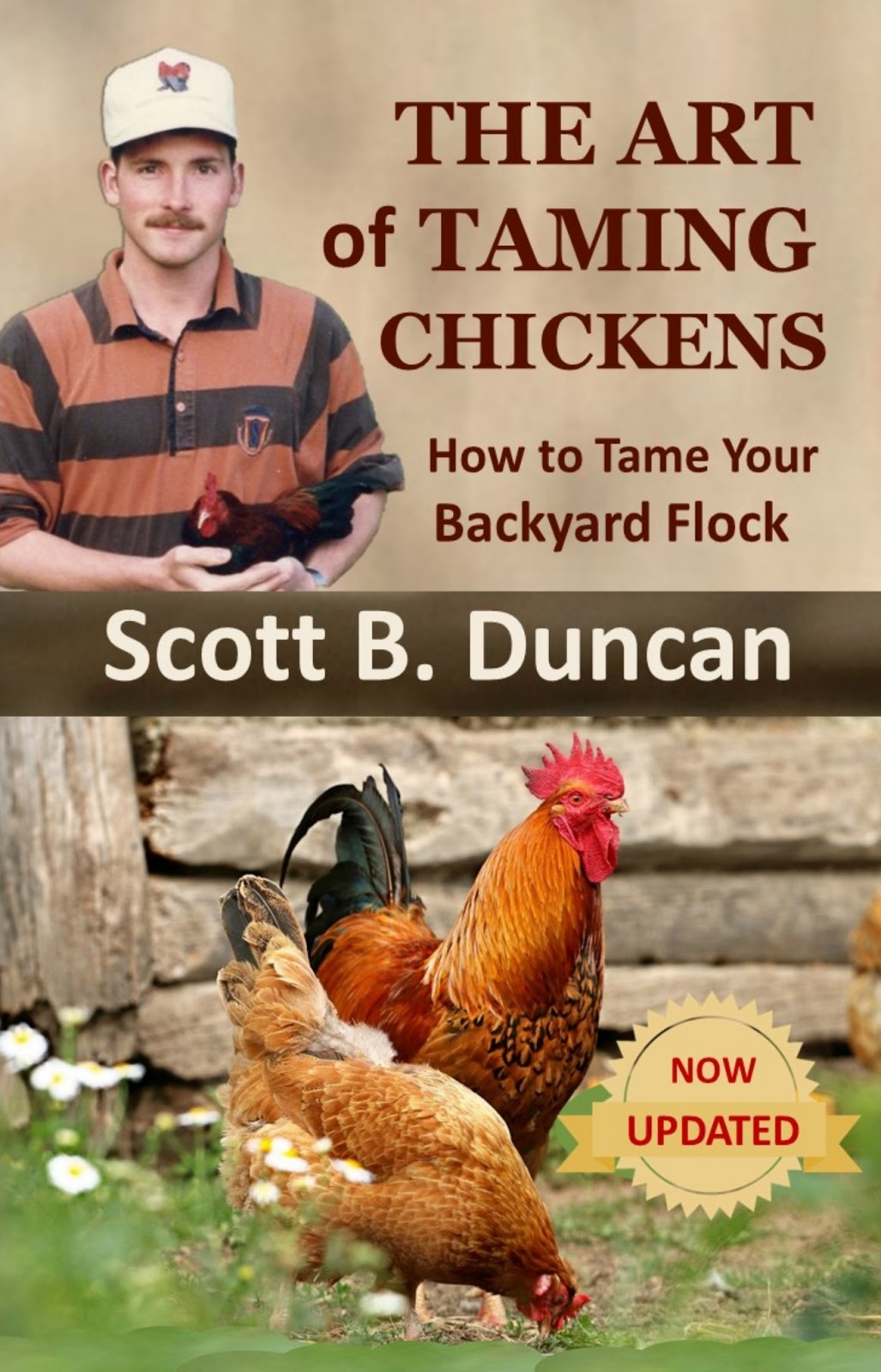
If you bought this e-book after it was published in 2012, you should be getting an email from Amazon letting you know that you can now download this update, at no charge.
This was the first book I'd ever written and in retrospect I realized it needed to be improved! Big time! Now, according to Amazon, this update is considered a "MAJOR quality improvement" . . . doesn't say much for the original, but I do hope you'll take the time to download this update.
Would love to hear your thoughts about it; just email scott@fortheloveofchickens.com. Or, leave a review, it will be much appreciated!
The paperback version, which should be published soon is 78 pages - and the original e-book was only 30-something. I believe you'll enjoy the content of this update - and you deserve it!
Because I don't appreciate chicken images in gray-scale, I chose white paper and full color for the paperback version - a bit more expensive to produce.
If you love chickens as much as I do, though, you'll probably appreciate the added quality.
If you didn't purchase the e-book, here's a link where you can check it out if you'd like:
amazon.com/Art-Taming-Chickens-Backyard-Flock-ebook/dp/B008OR9EEY/
Thursday, January 26, 2017
Carol Ekarius, NEW Book, POULTRY BREEDS - Review
POULTRY BREEDS, a book you can easily carry!

This little book is so handy, measuring at just 6" x 4.25" and not quite an inch thick, this is one of those examples of big things that come in small packages! Ideal to have in your handbag or pocket, especially when you're at a chicken show or local fair.
The Content:
Not JUST chickens - Ducks, Geese and Turkeys, too! Beautiful images, breed descriptions and lot's of "extras"!
Ever puzzled over breed names including words like "Mottled", Spangled", "Splash", "Laced", "Partridge", "Penciled", etc.? Well, not to worry; this little book solves those mysteries!
Plus, a complete up-to-date list of the breeds and all APA approved varieties. And, a comprehensive list of specific breeds websites and poultry organizations! 104 breeds!
Will certainly add value to any poultry enthusiasts library . . . now,
Where can you get this valuable resource?
Most online book sellers, such as Barnes and Noble and Goodreads. Some hatcheries, as well.
Saturday, December 31, 2016
Happy New Year!

Well, 2016 sure flew by fast, didn't it? As I'm writing this, it's less than three hours until 2017 officially begins. Guess that's an indication of what a wild 'party animal' I am. No apologies, I do love my solitude. . . it's refreshing after long hectic work hours.
Hope your Christmas was very special! It snowed a little where I live, but I was able to get out and visit family; had a wonderful visit. Great food, and company, too.
Soon, we'll see signs of Spring, and thoughts will turn to things like gardening, and getting a few chickens, too. Right?
Will keep this post short, but just want to raise my glass in a toast to you and yours. "To a very happy, healthy and successful New Year!" Actually, I'm drinking a delicious mug of hot chocolate, but that shouldn't be a problem, as the wish is sincere.
In a couple of days I'll tell you about my friend (and business partner) Carrie's new book . . . she's running a bit behind schedule, but will soon have it published.
Have a safe fun New Years Eve and do drive carefully if you'll be out and about!
Monday, December 19, 2016
The Importance of The American Poultry Association to Chicken Keepers
The American Poultry Association, The Authority on Breed Standards . . .
Every backyard or rural chicken keeper can benefit by learning about the breeds of chickens and other poultry. Every industry needs to set and maintain standards and anyone who raises chickens could be considered a participant in the chicken industry.
At least as a responsible consumer.
If you live elsewhere in the world, there is a standard for you to learn from, too:
 |
| The American Poultry Association Standard of Perfection, British, Australian chicken breed Standards |
It is my understanding that quite a few shows in Europe go by the British Standard in their poultry exhibits. Australia has their own, and I'm not aware of any other countries that have a standards book. Victoria Roberts is the editor of the British Standard. She's very knowledgeable. I have a CD of hers and a book she wrote that I really enjoy, too.
The American Standard lists breed according to Class, then variety. The British standard classifies breeds according to feather type.
The American Poultry Association was formed in 1873 with the goal:
"to stabilize our economic and commercial breeds to uniform size, shape and color, with good production and practicality; with provision that ornamental breeds, including the Bantam, be attractive, productive and meet requirements of the Standard breeder."
~American Standard of Perfection, 1993 edition
New editions of the American Standard are published periodically as new breeds are admitted. Whether or not you've ever exhibited your poultry - or ever plan to do so - having a copy of the Standard is a huge advantage.
In it, you learn the following requirements for each breed, male and female:
- Proper comb type
- Number of toes
- Beak type and color
- Earlobe color
- Leg color
- Eye color
- Beards, muffs or tufts, if applicable
- . . .and much, much more
Including, Disqualifications and Defects.
If you're only interested in having fresh eggs, rather than learning all that the Standard contains, but would like to get more enjoyment from attending a chicken show, you might like the "chicken Show appreciation chapter I included in The Art of Taming a Chicken . . . How to Tame Your Backyard Flock.
It's in paperback on Amazon, Barnes and Noble, etc.
https://www.amazon.com/Art-Taming-Chicken-Backyard-Flock/dp/1539772063
https://www.amazon.com/Art-Taming-Chicken-Backyard-Flock/dp/1539772063
Tuesday, December 13, 2016
Frozen Chicken? Alive and Well! Never Give Up


Yes, sweet precocious little "Timmy" - nicknamed 'the little rascal'. Four nights ago when I went out to put the chickens in the coop, he was nowhere to be found. The next morning my heart broke when I saw him. He was soaked, and so cold - not at all good for a Silkie! I picked him up and brought him inside, blotted him with towels, I set him in a box with dry towels while getting one of my carriers and padding it with straw. He stayed in for four days. First day, showed signs of life, but wouldn't eat.
The next day he ate a little, and the third day, he ate pretty well, but still slept a lot and didn't look at all spiffy. He's back outside now, though, and is active and back to normal. Thank God! I sure didn't want to lose him, But when I brought him in I really didn't have much hope for him.
It was kind of strange how I got the little guy; an unusual call from a man my dad used to work with asking if I'd like a pair of Silkies. Of course I didn't hesitate. There's always room for one more (or two). Well, there are those pesky space requirements, but I have a pretty big place.
He and his mate fit right in with the layers - they teamed up every evening to guide any stragglers into the coop. He and "Lula" are back together now doing their thing.
Thought you might like to hear about what I certainly regard as a little miracle, seeing as it is almost Christmas.
May you have many miracles, too, both big and small!
Subscribe to:
Posts (Atom)
Featured Post
In Gratitude to Chickens - For Centuries of Service to Humans
In Gratitude to Chickens - for Centuries of Service to Humans The purpose of this book is to debunk the common stereotypes about ...
